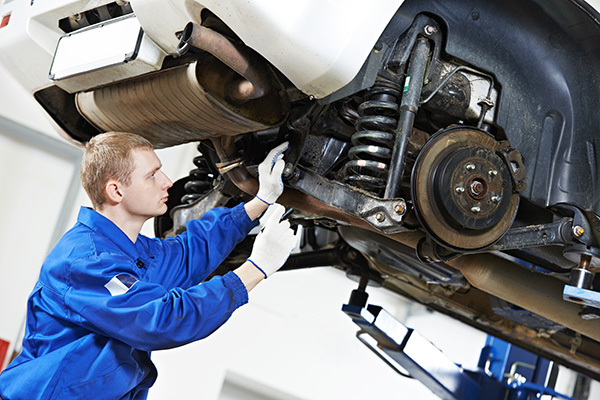
Your suspension takes a beating every time you hit potholes, speed bumps, and rough patches of road. Over time, parts like shocks, struts, bushings, ball joints, and sway bar links wear down, and the car starts to feel different in ways most drivers notice. A simple inspection can usually tell whether you are dealing with normal aging or a part that is ready to be replaced. Catching the signs early also helps protect your tires and keeps the car predictable when you need to brake or steer quickly.
1. Excessive Bouncing After Dips And Speed Bumps
A healthy suspension settles quickly after a bump. If the vehicle keeps bouncing two or three times after a dip, the shocks or struts are often worn and no longer control the spring movement. You may also notice the front end bobbing more than it used to on uneven streets. This can reduce traction because the tires are spending less time firmly planted on the pavement.
Sometimes the bouncing is most obvious on the highway, where small waves in the road can set off a floaty, unsettled feeling. If you find yourself backing off the throttle because the car feels too busy over mild bumps, that is a solid clue. The fix is not always shocking alone, but that is a common starting point.
2. Clunking Or Rattling Over Rough Roads
A sharp clunk when you hit a pothole often points to looseness in the suspension or steering linkage. Worn sway bar links, tired bushings, or play in a ball joint can all make noise when the wheel takes a quick hit. Rattles over washboard roads can also come from mounts that no longer hold components tight. If the sound is new and repeatable over bumps, it is worth checking sooner rather than later.
One detail that helps is where you hear it. A front-end clunk during low-speed bumps feels different than a rear rattle over broken pavement. Even if the car still drives fine, noises usually mean something is moving more than it should.
3. Uneven Tire Wear You Cannot Explain
Tires can wear oddly for a few reasons, but suspension wear is a common culprit. If you see cupping, scalloped patches, or a sawtooth pattern around the tread, the tire may be bouncing as it rolls. Worn shocks and struts allow that up-and-down motion, and the tire loses consistent contact with the road.
Alignment angles can also drift when bushings soften or joints loosen. That is why regular maintenance matters, even if the car seems to handle okay. A tire wear pattern can be the first visible sign that something underneath is no longer holding geometry where it belongs.
4. Nose Dives When Braking Or Squats On Acceleration
Some weight transfer is normal, but excessive nose dive under light braking can signal weak front struts or shocks. When the front end drops too much, the vehicle can feel unstable, and braking distances can increase because the tires are not loading evenly. On the flip side, if the rear squats hard during acceleration, rear shocks may not be controlling the rear spring movement.
Drivers often describe this as the car feeling dramatic with simple pedal inputs. You tap the brakes and the front seems to drop like it is falling forward. If that description fits, the suspension is not damping movement the way it should.
5. Steering Feels Loose Or Wanders At Speed
If you are constantly making small steering corrections to stay in your lane, something may be worn in the steering or front suspension. Play in tie rod ends, control arm bushings, or ball joints can make the car wander, especially on grooved highways. You might also feel a delay between turning the wheel and the vehicle responding.
This can sneak up on you because it builds gradually. One day you realize the car feels tired, like it does not want to track straight. That is often a safety issue, because a loose front end can react unpredictably during emergency maneuvers or hard braking.
6. Vehicle Leans Too Much In Turns
Body roll is normal, but if the vehicle leans noticeably more than it used to, the suspension may be losing control. Worn shocks and struts contribute, but sway bar links and bushings are also key players here. When those parts wear out, the car can feel top-heavy in turns, even at moderate speeds.
You may also notice a rocking motion after a turn, like the vehicle takes a moment to settle back down. That kind of delayed settling is a sign the suspension is not managing weight transfer well. If you feel less confident in corners than you used to, it is time to have the suspension checked.
Get Suspension Repair In Corpus Christi, TX With Dub's Garage
If you’re dealing with bouncing, clunks, uneven tire wear, or loose handling, the next step is having the suspension checked so it’s fixed correctly.
Schedule service or visit Dub's Garage in Corpus Christi, TX when you want a clear answer and a repair that holds up.